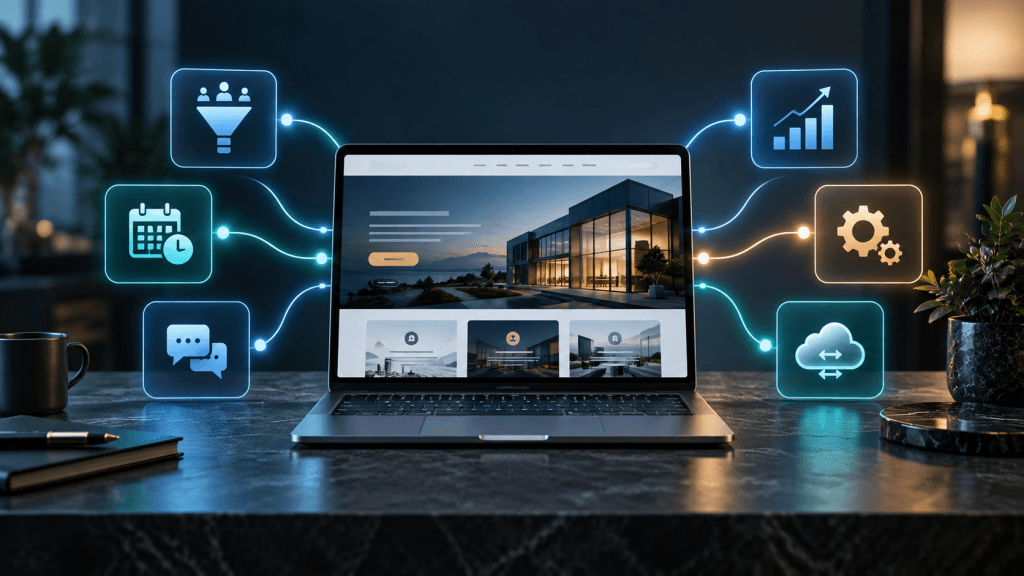
A beautiful website can still be a poor business tool.
It might have modern colors, attractive photographs, smooth animations, and carefully written content. But if it doesn’t generate inquiries, simplify customer interactions, reduce repetitive work, or support the way your business operates, it may not be accomplishing very much.
A website with a professional look matters. Your website is often one of the first places prospective customers encounter your business, and its appearance influences whether they trust you enough to keep exploring.
But a good design should be the beginning—not the end.
Today, a business website can do far more than present information. It can become an active part of your operation: attracting the right customers, collecting useful information, automating routine tasks, connecting existing systems, and helping your team work more efficiently.
The better question is no longer simply, “Does our website look good?”
It’s:
“What is our website actually doing for our business?”
A Website Is Not Just an Online Brochure
Many business websites still operate like digital brochures. They explain what the company does, provide contact information, and perhaps include a form that sends an email.
That may have been enough in the past, but it’s usually not enough now.
Consider what happens after someone submits a basic contact form. An employee may need to:
- Read the inquiry
- Ask the customer for missing information
- Enter the details into another system
- Determine which employee should respond
- Schedule an appointment
- Send forms or instructions
- Follow up if the customer does not reply
The website technically generated a lead—but it also created a chain of manual tasks.
A more capable website could collect the right information from the beginning, route the inquiry to the appropriate person, add the prospect to a customer-management system, initiate a personalized response, and provide the next step automatically.
That’s the difference between a website that merely exists and one that actively supports the business.
It Should Attract the Right People
More website traffic is not always the real goal.
If visitors don’t understand what you offer, whether it’s right for them, or what they should do next, higher traffic may accomplish little. A successful website helps the right people recognize that they’re in the right place.
That requires clear answers to a few basic questions:
- What problem does your business solve?
- Who do you solve it for?
- What makes your approach different?
- What should the visitor do next?
These answers should not be buried under clever headlines or technical language. Visitors should be able to understand your business within seconds.
Strong website content also helps filter inquiries. When services, expectations, processes, and qualifications are communicated clearly, potential customers can make better-informed decisions before contacting you.
That means your website can help produce not just more leads, but better more qualified leads.
It Should Turn Interest Into Action
Every business website should have a purpose.
That purpose might be requesting an estimate, scheduling a consultation, completing an application, registering for an event, purchasing a product, making a donation, or calling the business.
Whatever the objective, the website should make that action easy.
A visitor should not have to search for the next step, navigate a confusing menu, or complete a form that asks for unnecessary information. Calls to action should be clear, forms should be intuitive, and the experience should work just as well on a phone as it does on a desktop computer.
This is where design and business strategy need to work together. The most visually striking design is not necessarily the most effective one. Good design directs attention, reduces uncertainty, and helps people move forward confidently.
A website succeeds when it removes friction between a visitor’s interest and the action the business wants that visitor to take.
It Should Reduce Repetitive Work
Many tasks that consume a business owner’s time follow predictable patterns. Those patterns often make them good candidates for automation.
Depending on the business, a website can help automate:
- Appointment scheduling and reminders
- Lead qualification and routing
- Customer onboarding
- Registration and application processes
- Estimates and quote requests
- Document collection
- Frequently asked questions
- Review requests
- Follow-up emails
- Internal notifications
- Recurring reports
Automation does not have to mean removing people from the customer experience. In many cases, it does the opposite.
When technology handles repetitive administrative steps, employees have more time for conversations, problem-solving, and personal service. Customers also receive faster responses and are less likely to fall through the cracks.
The goal is not to automate everything. It is to identify the right tasks—the ones that are repetitive, time-consuming, and vulnerable to delay or human error.
It Should Connect the Tools You Already Use
Most businesses rely on more than one system. They may use separate platforms for email marketing, customer management, scheduling, payments, accounting, inventory, forms, or project management.
The problem begins when those systems do not communicate.
Employees end up copying information from one place to another. Customer records become inconsistent. Important details remain trapped in individual inboxes. The business pays for several capable platforms but still depends on spreadsheets and manual data entry to hold everything together.
A website can serve as the connecting point between these tools.
Through integrations and APIs, information submitted through the website can be securely sent where it needs to go. A new inquiry might create a CRM record, notify the right employee, begin an email sequence, and add an appointment to a shared calendar—all without requiring someone to reenter the same information.
Sometimes the most valuable website improvement is not something customers can see. It is the invisible connection that saves the business hours of work every week.
It Should Support Your Actual Workflow
Off-the-shelf plugins and software can solve many common problems. They are often the fastest and most economical place to begin.
But every business operates a little differently.
Eventually, some companies find themselves changing their processes to accommodate their software. Employees develop workarounds. Information gets tracked in multiple places. A tool provides twenty features the business never uses while missing the three it actually needs.
That is when custom development may make sense.
A custom web application, customer portal, internal dashboard, or specialized workflow can be designed around how the business really works. It does not necessarily need to replace every existing system. Often, the best solution connects existing tools and fills the gaps between them.
Custom development should not begin with technology for technology’s sake. It should begin with a clearly defined business problem.
What is taking too long? Where are mistakes occurring? What information is difficult to access? What frustrates customers or employees?
Once the problem is understood, the appropriate technology becomes much easier to determine.
It Should Provide Useful Information
Your website can also help you understand what prospective customers need.
Website analytics can reveal:
- How people find the business
- Which services receive the most attention
- Where visitors leave the site
- Which calls to action generate responses
- Which marketing campaigns produce meaningful inquiries
- What questions customers ask most often
The objective is not to collect data simply because it is available. It is to gather information that supports better decisions.
For example, if a service page receives significant traffic but produces few inquiries, the problem may be unclear messaging, missing information, weak calls to action, or an unnecessarily complicated form. Without measurement, the business may never recognize the missed opportunity.
A good website should not remain frozen after launch. It should improve as the business learns what its customers need and how they behave.
What Is Your Website Doing for Your Business?
You do not necessarily need a complicated website, an expensive custom application, or automation attached to every process.
You need technology appropriate to your goals.
Start by asking:
- Does our website clearly explain the problems we solve?
- Does it attract the kinds of customers we want?
- Is it easy for visitors to take the next step?
- Does it collect the information our team actually needs?
- Are employees repeatedly transferring website data into other systems?
- Could routine customer communication happen more efficiently?
- Are there manual processes causing delays or mistakes?
- Can we measure whether the website is producing meaningful results?
The answers will help reveal whether your website is simply representing your business or actively contributing to it.
Build Around the Problem, Not the Technology
A website should certainly look professional. It should also be fast, accessible, secure, and easy to use.
But its greatest value comes from what it enables the business to accomplish.
Sometimes that means creating a clearer path from a Google search to a consultation. Sometimes it means automating an application process, integrating disconnected systems, or building a custom tool that does not yet exist.
The right solution begins by understanding the business—not by choosing the technology first.
At MK Web Development, that is the principle behind everything we build: websites, custom applications, automations, and integrations designed around real business needs.
Because your website should do more than just look good.
It should work for your business.
A professional design matters, but your website should be more than a digital brochure. Discover how the right website can attract better leads, automate routine work, connect existing systems, and actively support your business.